
I. Introduction
Nutrition is a key driver of profitability in laying hen operations. Getting it right demands solid zootechnical and health knowledge of the various laying hen strains, combined with high-performing, well-balanced feed formulation and a commitment to staying current on nutritional science, raw materials, and available inputs such as nutritional and zootechnical additives.
II. Feed Formulation
1. The Principle of Least-Cost Formulation
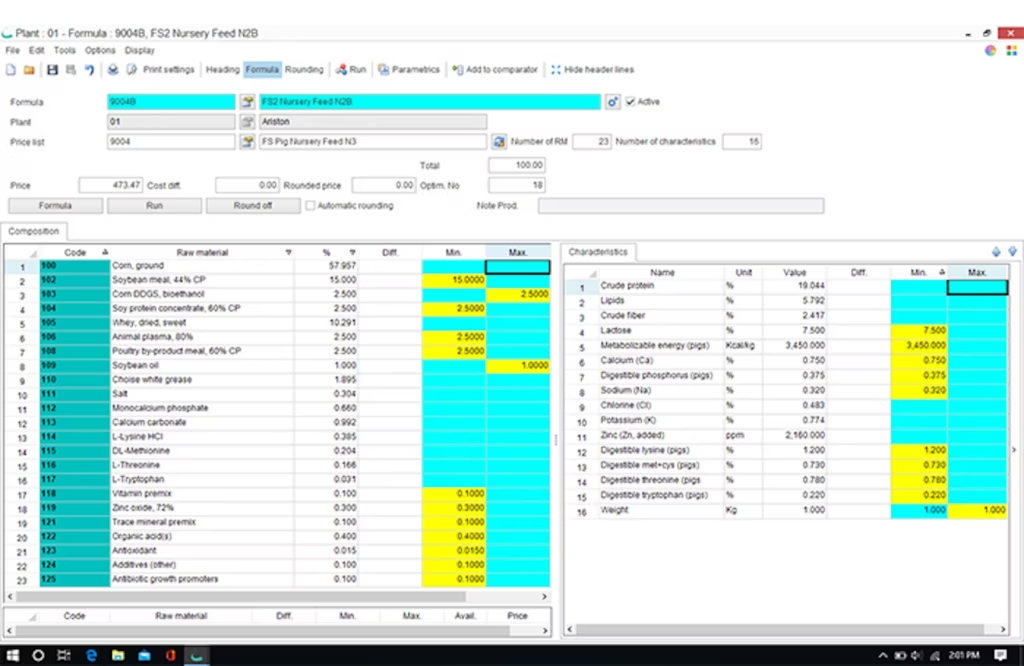
Feed accounts for over 65% of total production costs, making it essential to keep formula costs as low as possible while still meeting all nutritional needs and sustaining optimal hen performance. Least-cost formulation is the process of calculating the ideal proportion of each raw material; corn, soybean meal, sunflower meal, and so on; to include in a complete feed. It takes into account:
- The nutritional requirements of the target strain at its specific physiological and production stage (starter, grower, peak lay, etc.);
- The availability and cost of raw materials;
- The nutrient profile of each ingredient;
- Constraints related to anti-nutritional factors, as well as the impact of each ingredient on the physical properties of the mix and its behavior during processing (flowability, pellet quality, etc.);
- Market requirements and farmer preferences, particularly when specific physical characteristics such as feed color are requested.
Effective least-cost formulation can significantly reduce overall production costs. Conversely, even a small error at any step of the process can prove expensive, both in terms of higher feed costs and lost performance.
A range of software tools, varying in sophistication and based on different mathematical models, are available to automate these calculations and identify the lowest-cost blend that satisfies all constraints defined by the nutritionist: target nutrient levels, minimum and maximum inclusion rates, specific additive doses, mycotoxin risk management, and more. Such tools become especially valuable when a large number of raw materials are in play.
2. Balancing the Feed Formula
Nutritionists employ a variety of strategies to achieve a balanced supply of energy and protein. The formula’s energy and protein/amino acid content must support optimal metabolic function and protein synthesis while keeping nitrogen excretion to a minimum.
Regardless of the approach chosen, we recommend adhering strictly to the nutritional requirements needed to meet production targets.
Over-supplying any single nutrient; whether energy, protein, or amino acids, is not just wasteful and costly; it can actually hurt performance by creating imbalances between energy and protein or between calcium and phosphorus. In some cases, excess can even become toxic: methionine, for instance, causes adverse effects when supplied at more than three times the requirement.
The electrolyte balance also deserves attention during formulation, given its influence on acid-base metabolism and its role in eggshell formation.
3. Formulating for Table Egg Laying Hens
The first set of nutritional recommendations for laying hens was published by the US National Research Council (NRC) in 1944. Since then, laying hen genetics have advanced dramatically, and today’s strain producers provide highly detailed nutritional guidelines.
The most critical formulation parameters are energy, amino acids, crude protein, calcium, and phosphorus. Because these requirements evolve throughout the hen’s life, two broad phases can be distinguished:
- The rearing phase (starter from 0 to 6 weeks; grower/developer and pre-lay up to 17 weeks), where the focus is on pullet growth and prevention of viral, bacterial, and parasitic diseases that could impair future performance.
- The production phase (from onset of lay to end of cycle), where the priority shifts to meeting nutritional needs while optimizing formula costs.
Calcium management is especially critical for laying hens. The calcium requirement for strong, high-quality eggshells increases four to five fold at the onset of lay. A gradual increase in calcium supply should therefore begin during the pre-lay period. The physical form in which calcium is provided also matters.
III. Premixes in Laying Hen Feed
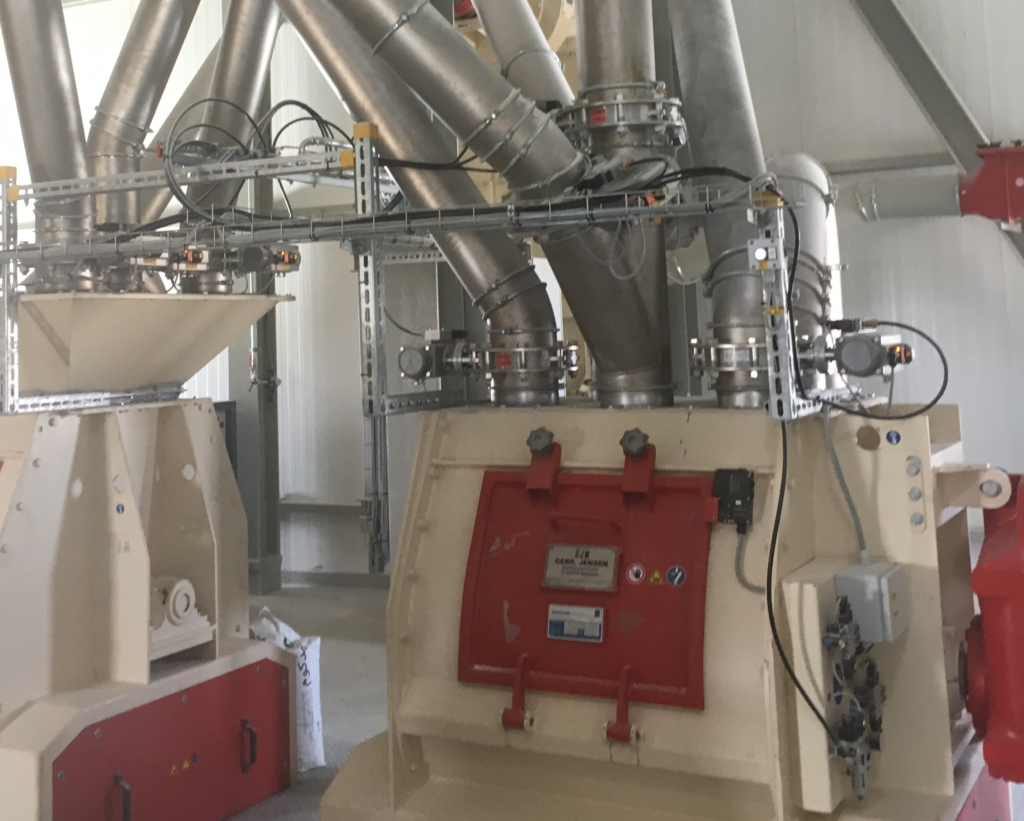
Premix inclusion is essential in laying hen feed, just as it is for broilers, turkeys, and breeders. What sets the laying hen sector apart is that producers frequently operate their own on-farm feed mills. This vertical integration allows a single operator to monitor all nutritional and zootechnical parameters on a continuous basis.
The nutrients naturally present in raw materials are insufficient to meet the demands of high-producing laying hens. Supplementation with vitamins, minerals, amino acids, and other additives is therefore necessary to achieve a fully balanced feed.
Because these supplements are needed at very low inclusion rates, a preliminary premixing step is required to ensure homogeneous distribution in the final feed. The resulting premix is then incorporated at a more practical dosage. Inclusion rates vary: 4% premixes (40 kg per ton of feed), 1% (10 kg/T), 0.5% (5 kg/T), and so on.
The chosen inclusion rate depends on the volume of additives contained in the premix. Certain high-volume additives are increasingly added directly at the feed mill, provided the facility has adequate mixing and homogenization capacity.
Outside of large integrated operations that produce their own premixes, manufacturing is typically handled by specialist companies known as premixers. Their role extends beyond production to include technical support, formulation guidance and nutritional advice, for the feed mills and on-farm manufacturers they serve.
Each premixer develops proprietary expertise in premix and complete feed formulation, striving to deliver optimal nutritional coverage and zootechnical performance (lay rate, feed conversion ratio, etc.). Professionals in this field typically draw on specialists trained at dedicated university programs.
IV. Additives in Laying Hen Premixes
Beyond the additives required for basic nutritional coverage (vitamins, minerals, trace elements, amino acids), several zootechnical additives are included in premixes to optimize technical and economic performance. These fall into three categories by mode of action:
- Improving raw material digestibility and managing feed formula costs;
- Managing gut microflora;
- Mitigating mycotoxin risk.
1. Improving Digestibility and Managing Feed Costs
Enzymes rank as the single most impactful zootechnical additives. Their effect on formula economics is so substantial that achieving competitive profitability without them is virtually impossible today. A critical consideration given that feed is the largest cost item in any poultry operation.
Exogenous enzymes are now used routinely in poultry nutrition to:
- Neutralize anti-nutritional factors present in raw materials;
- Make nutrients more accessible to the animal’s own digestive enzymes;
- Break down chemical bonds that the animal lacks the endogenous enzymes to hydrolyze;
- Compensate for limited enzyme production in immature digestive tracts (young birds).
Careful selection and rational use of enzyme products is essential. The digestibility improvement they deliver enables the establishment of formulation matrixes (nutritional values attributed to the additive) tailored to the specific enzyme and the raw materials in the formula. Properly calibrating and validating these matrixes is key to maintaining both nutritional supply and performance at their optimum.
Several enzyme types are used across poultry species, including laying hens. The main categories are:
a. Phytases
Phytases hydrolyze phytic acid (phytates) in cereals, releasing phosphorus that the animal can then absorb. This unlocks plant-bound phosphorus and substantially reduces the need for supplemental inorganic phosphate in the feed.
Product efficacy varies widely depending on enzymatic activity levels, heat stability during pelleting, and, crucially, stability during transport and storage. When temperature conditions are not properly maintained, enzymatic activity can drop by as much as 70% between manufacture and actual use at the feed mill.
b. Xylanases and Other Carbohydrases (NSPases)
These enzymes break down hemicelluloses, arabinoxylans and glucans found primarily in plant cell walls, that the animal cannot digest on its own. By converting these complex carbohydrates into smaller polysaccharides, exogenous carbohydrases improve both the energy and protein value of the diet.
c. Proteases
Proteases cleave dietary proteins into smaller peptide fragments, facilitating absorption in birds whose endogenous protease levels may be insufficient. Their benefits extend beyond feed cost savings: by supporting better protein digestion, they also contribute to a healthier intestinal flora balance.
Technological progress in this field has been rapid over the past two decades. Today’s best-performing enzyme products deliver very significant cost reductions. Notably, the operations that managed feed costs most effectively are also the ones that best weatherg market crisis.
2. Gut Flora Management
Every poultry operation faces microbial pressure that must be managed through multiple measures: thorough cleaning between flocks, proper drinking water treatment, and proactive regulation of intestinal microflora. The gut acts as the primary reservoir where microbial populations multiply.
Neglecting intestinal flora regulation exposes flocks to the proliferation of pathogens such as E. coli, leading to digestive disorders including diarrhea. It also creates a cycle of repeated antibiotic treatments that provide only temporary relief, as long as the root cause, uncontrolled microbial pressure, remains unaddressed.
Several categories of additives are used for flora regulation. The main ones are:
a. Essential Oils and Plant Extracts
- Mode of action: Depending on the product and dosage, they act by coagulating bacterial cytoplasm, aggregating DNA, or disrupting the bacterial cell wall.
- Strengths: Proven antibacterial activity.
- Limitations: Non-selective action (potential harm to beneficial flora), narrow safety margin (the effective dose often sits dangerously close to the toxic dose, risking enteritis), and frequently high cost.
- Bottom line: These products can be effective, provided the supplier has genuine expertise in both phytotherapy and poultry production. Poor product selection carries a real risk of economic losses.
b. Probiotics
- Mode of action: Live yeasts or bacteria (the latter generally being more effective) that support a healthy gut flora balance, not through direct antibacterial action, but by outcompeting pathogenic organisms for resources and colonization sites.
- Strengths: Help suppress pathogenic flora proliferation. No toxic effect from accidental overdosing.
- Limitations: High cost and sensitivity to antibiotics used on-farm. In markets where registration is required, manufacturers must demonstrate that probiotic strains are susceptible to all antibiotics; precisely to prevent resistance transfer to pathogenic bacteria.
- Bottom line: Some products have a strong track record, but in our view they are best suited for tightly integrated operations with seamless coordination between the feed mill and the farm. This applies primarily in regions where antibiotic use is restricted.
c. Organic Acids
- Mode of action: They lower intracellular pH in bacteria and deplete their energy reserves. They are most effective in their undissociated form; once dissociated in the intestinal lumen, the Minimum Inhibitory Concentration (MIC) can increase by a factor of 100, drastically reducing efficacy. Microencapsulation technology, now widely adopted by leading manufacturers, largely overcomes this limitation.
- Strengths: Proven antibacterial effect with selective action against pathogens. Beneficial lactic acid bacteria, being acid producers themselves, are naturally resistant to this mechanism.
- Limitations: In their unprotected form, organic acids dissociate early in the gut, limiting their reach to the upper digestive tract. Cost of microencapsulation can be very high.
- Bottom line: Microencapsulation protects organic acids from premature dissociation and enables gradual release throughout the digestive tract, improving efficacy while reducing the required dose.
3. Mycotoxin Risk Management
Mycotoxin binders are included in laying hen feed to reduce mycotoxin absorption and prevent both clinical mycotoxicoses (now rare in modern poultry production) and the subclinical effects (reduced lay rate, immunosuppression, poor zootechnical performance) that silently erode farm profitability.
Laboratory testing for mycotoxins in raw materials is only as reliable as the sampling protocol behind it. Fungal contamination tends to be unevenly distributed, and a non-representative sample can easily produce false negatives.
Where a robust sampling and testing program is not in place, the most prudent approach to mycotoxin risk is the preventive use of binders. The most widely used products are based on mineral adsorbents (clays), modified or unmodified, as well as yeast cell walls that are particularly effective against zearalenone (ZEA) and that also support immune recovery following mycotoxin exposure.
A comprehensive mycotoxin strategy must also address the downstream consequences of contamination (primarily immunosuppression and liver toxicity) through targeted feed formulation adjustments or the use of hepatoprotective and immunostimulant additives.
V. Conclusion
Given the many parameters discussed above, it is clear that successful laying hen nutrition is a job for dedicated professionals. The nutritionist’s role (whether in-house at the feed mill or through a premixer’s support) must extend well beyond formulation. Deep knowledge of the additive market, both from a technical and economic standpoint, can make a decisive difference in an increasingly competitive industry where profitability is paramount.
Beyond the nutritional concepts briefly outlined here, the nutritionist must also maintain up-to-date expertise in feed manufacturing technology. The physical quality of the feed (particle size, moisture content, pellet hardness) plays a significant role in feed intake and, ultimately, economic performance.
Of course, technical results in the field also depend on factors beyond nutrition: chick quality, health management, housing conditions, and more. When these are well controlled, feed efficiency is maximized. When they are not, even the best-formulated feed cannot compensate for degraded farm conditions, to say nothing of the increased disease risk.