
Where the problem starts
In plant feedstuffs such as corn, wheat, soybean meal and rapeseed meal, most of the phosphorus is not free. It is stored as phytate (phytic acid, or IP6): a myo-inositol ring carrying six phosphate groups. Depending on the ingredient, phytate often holds two thirds of total phosphorus, sometimes more.
Poultry produce almost no phytase of their own. Without help, most of this phosphorus passes through the gut unabsorbed and ends up in the litter. To meet requirements, nutritionists add inorganic phosphate (MCP, DCP). In other words, the feed mill pays for phosphorus twice: once in the raw materials, and again in the phosphate bag.
How phytase releases phosphorus
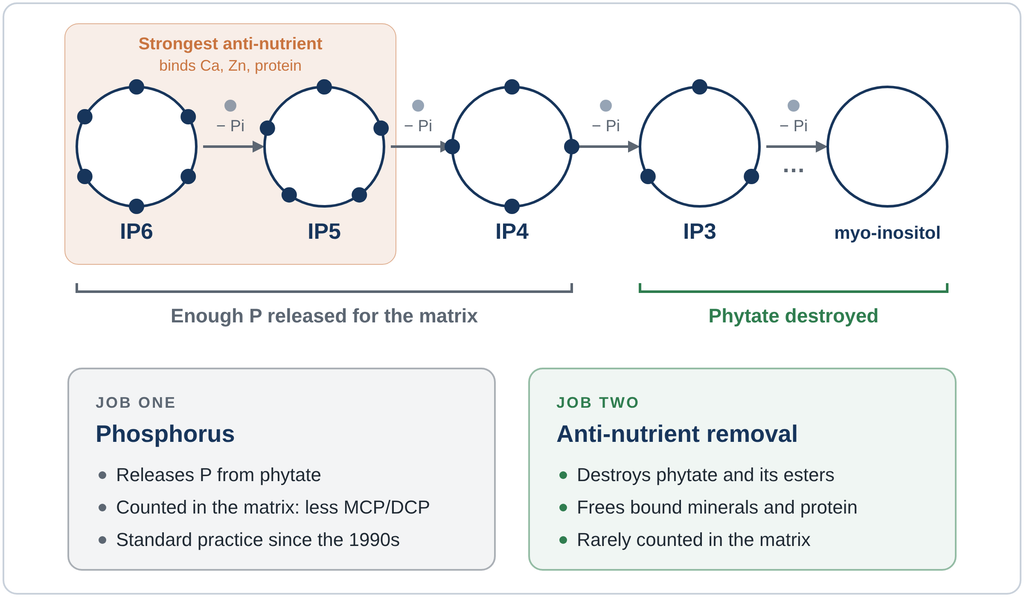
Phytase removes phosphate groups one at a time: IP6 to IP5, then IP4, IP3 and so on. Each cut frees a phosphate the bird can absorb.
Almost all of this happens before the small intestine. It starts in the crop, where feed is moistened and the pH is moderately acidic. It continues mainly in the proventriculus and gizzard, where the very acidic environment keeps phytate in solution. Further down, the pH rises, phytate precipitates with minerals and the enzyme can barely reach it. Phytase works in a short window. What is not broken down in the upper gut is rarely broken down later.
Job one: releasing phosphorus
Phytase suppliers recommend matrix values: the amount of available phosphorus (and calcium) the enzyme is expected to release at a given dose. The nutritionist decides how much of that to apply, and takes MCP or DCP out of the formula accordingly. This is the phosphorus effect. It is well understood, quantified, and has been built into formulations for more than thirty years.
Job two: destroying an anti-nutrient
Phytate is not just phosphorus the bird cannot reach. It is one of the most potent anti-nutrients in plant-based feed. It binds zinc, iron and calcium, forms complexes with proteins and digestive enzymes, and increases endogenous losses of mucin and amino acids. The intermediate esters (IP5, IP4) keep part of that effect.
The further phytate is broken down, the more that brake is released. The literature calls this the extra-phosphoric effect. At the end of the chain sits myo-inositol, which several trials have associated with better performance, although the mechanism is still debated.
This second job does not appear in the matrix, or only partly, through the energy and amino acid values some suppliers propose and many nutritionists apply with caution.
Superdosing did not come out of nowhere
In 1990, Simons et al. first showed that a microbial phytase could improve phosphorus availability in broilers and pigs. The first commercial product followed a year later in the Netherlands, driven by rules on phosphorus emissions. For about a decade the reference dose stayed around 500 FTU/kg, with one goal: replacing inorganic phosphate.
In the early 2000s, university groups began testing far higher doses. At the University of Georgia, Shirley and Edwards (2003) went up to 12,000 FTU/kg and saw performance gains beyond what phosphorus alone could explain. At the University of Illinois, Augspurger and Baker (2004) showed that high doses break down a much larger share of phytate.
In 2011, Cowieson, Wilcock and Bedford gave the concept its name: superdosing. This means doses of 1,500 FTU/kg or more, aimed at near-complete destruction of phytate and its intermediate esters, and at releasing myo-inositol. In 2014, Walk et al. confirmed that such doses sharply reduce residual phytate in the gizzard and raise inositol levels. Doses of 1,500 to 2,500 FTU/kg are now common in broiler feed. Recent reviews (Selle et al., 2023) conclude that the responses are real but variable, depending on dietary phytate content, calcium and phosphorus levels, and the enzyme used.
Superdosing also means more phosphorus
Higher doses also release more phosphorus, with diminishing returns: each additional FTU releases less than the one before. How much depends on the phytate content of the raw materials.
Choosing the dose is an economic decision made by the feed mill. It depends on the price of phosphate, the phytate content of the formulas, the cost of the enzyme and the performance targets. When phosphate is expensive, job one often justifies a higher dose on its own. When phosphate is cheap, the case rests more on job two. Either way, the mill is not only buying phosphorus. It is also buying the removal of an anti-nutrient.
Two conditions for job two to happen
First, the enzyme has to survive pelleting. At 80 to 90 °C, a poorly protected phytase can lose a significant part of its activity. The activity on the label is not the activity delivered in the bird. Because phosphorus release follows a diminishing curve, losing part of the activity barely dents job one. Job two depends on high activity, and that is where the loss shows.
Second, consistency from batch to batch. A matrix or a superdosing strategy only makes sense if every batch delivers the stated activity.
The question to ask
In your formula, what do you actually count from your phytase: the phosphorus only, or the rest as well?
That is the conversation we want to have with you at EuroTier 2026, 10 to 13 November, Hall 22, Stand D18.
Dr. Léon Amaqdouf, a veterinarian with an M.Sc. in Molecular and Medical Bacteriology, is Managing Director of ADNIMALIS EUROPE, a French producer of feed additives for poultry and livestock.
References
- Simons P.C.M., Versteegh H.A.J., Jongbloed A.W. et al. (1990). Improvement of phosphorus availability by microbial phytase in broilers and pigs. British Journal of Nutrition 64(2): 525–540. https://doi.org/10.1079/BJN19900052
- Shirley R.B., Edwards H.M. Jr. (2003). Graded levels of phytase past industry standards improves broiler performance. Poultry Science 82(4): 671–680. https://doi.org/10.1093/ps/82.4.671
- Augspurger N.R., Baker D.H. (2004). High dietary phytase levels maximize phytate-phosphorus utilization but do not affect protein utilization in chicks fed phosphorus- or amino acid-deficient diets. Journal of Animal Science 82(4): 1100–1107. https://doi.org/10.2527/2004.8241100x
- Cowieson A.J., Wilcock P., Bedford M.R. (2011). Super-dosing effects of phytase in poultry and other monogastrics. World’s Poultry Science Journal 67(2): 225–236. https://doi.org/10.1017/S0043933911000250
- Walk C.L., Santos T.T., Bedford M.R. (2014). Influence of superdoses of a novel microbial phytase on growth performance, tibia ash, and gizzard phytate and inositol in young broilers. Poultry Science 93(5): 1172–1177. https://doi.org/10.3382/ps.2013-03571
- Zeller E., Schollenberger M., Kühn I., Rodehutscord M. (2015). Hydrolysis of phytate and formation of inositol phosphate isomers without or with supplemented phytases in different segments of the digestive tract of broilers. Journal of Nutritional Science 4: e1. https://doi.org/10.1017/jns.2014.62
- Selle P.H., Macelline S.P., Chrystal P.V., Liu S.Y. (2023). The contribution of phytate-degrading enzymes to chicken-meat production. Animals 13(4): 603. https://doi.org/10.3390/ani13040603